
Buying a home is one of the biggest investments most people make in their lifetime. But what happens when the builder fails to deliver on time, changes what was promised, asks for extra money, or simply doesn’t do what they agreed to do?
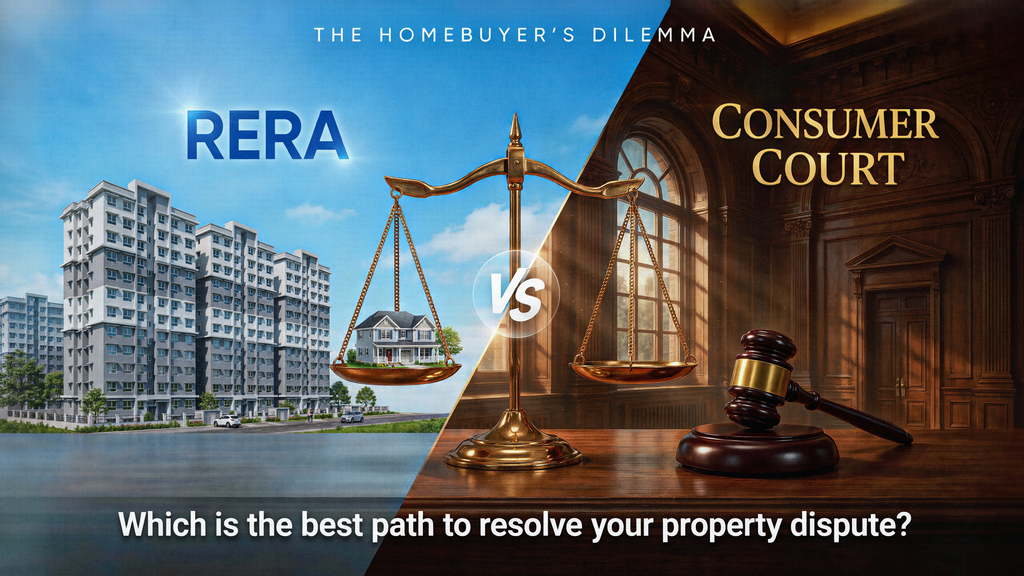
Homebuyers in such situations face an important conundrum that is, where should I file my complaint in RERA or in Consumer Court?
This question became very important after the
came into effect. RERA created a special system to regulate real estate and protect homebuyers. Because of this, many builders started arguing in courts that once RERA exists, homebuyers can no longer go to Consumer Court.
The Supreme Court clearly rejected this argument in its judgment dated 2 November 2020 in the case of M/s Imperia Structures Ltd. v. Anil Patni (Civil Appeal Nos. 3581–3590 of 2020).
The Court held that Consumer Court is an additional remedy not a replacement. This means RERA does not shut the door to Consumer Court. A homebuyer can choose where to go, depending on their case.
This article explains the judgment in simple language, helps you understand your rights, and compares the benefits and disadvantages of choosing one forum over the other.
- Two Laws, Same Issue
Before RERA came into force, homebuyers often went to Consumer Court for problems like:
• Delay in giving possession
• Promised amenities by the developer not provided
• Poor construction quality
• Unfair contract terms
• Refund not given
• False promises made during booking
The legal basis was simple: a homebuyer was treated as a consumer, and the builder was providing a service, then RERA was passed in 2016. It created:
• Real Estate Regulatory Authorities (RERA)
• Adjudicating Officers
• Real Estate Appellate Tribunals
• Rules that builders must follow
• Specific remedies for homebuyers, including for delayed possession
This raised an obvious question, does RERA replace Consumer Court?
The Supreme Court said No.
2. What Happened in the Imperia Structures Case?
The case was about a housing project called “The ESFERA” in Gurgaon, Haryana. The project started in 2011 and Homebuyers booked flats and signed agreements with the builder, despite paying large amounts, the project remained incomplete for years, in 2017, homebuyers filed a complaint in the National Consumer Disputes Redressal Commission (NCDRC).
The NCDRC found that the builder had failed to provide proper service. It ordered the builder to, Refund the money with interest and also Pay compensation. Thereafter the builder challenged this in the Supreme Court, arguing.
RERA now exists, So Consumer Court cannot hear these cases. the Supreme Court rejected this argument.
The Main Question Before the Supreme Court, Is RERA the only remedy available to homebuyers? Can they no longer go to Consumer Court?
The Supreme Court examined various section of the RERA act and consumer protection act like Section 18, Section 79, Section 88 of RERA and the Consumer Protection Act.
3.Supreme Court Reasoning and Analysis
The Apex Court started analysis with Section 18 of RERA which is reproduced here for making the understanding clear,
18. Return of amount and compensation
(1) If the promoter fails to complete or is unable to give possession of an apartment, plot or building,
(a) in accordance with the terms of the agreement for sale or, as the case may be, duly completed by the date specified therein; or
(b)due to discontinuance of his business as a developer on account of suspension or revocation of the registration under this Act or for any other reason,
he shall be liable on demand to the allottees, in case the allottee wishes to withdraw from the project, without prejudice to any other remedy available, to return the amount received by him in respect of that apartment, plot, building, as the case may be, with interest at such rate as may be prescribed in this behalf including compensation in the manner as provided under this Act:
Section 18 of RERA is very important. It deals with what happens when a builder, fails to complete the project, or does not give possession on time
It gives the homebuyer remedies like, withdraw from the project or get a refund with interest or get compensation.
But notice the opening words of Section 18, “Without prejudice to any other remedy available”. This means RERA remedy is not extinguishing other any other legal remedy the buyer already has.
Parliament did not say, this is the only remedy. The Supreme Court used this language to conclude that RERA does not take away other remedies like Consumer Court.
Then Apex Court moved its focus to Section 79 of RERA which says that civil courts cannot hear matters that RERA authorities can decide. Builders argued if civil courts are barred, then Consumer Courts should also be barred. this argument was rejected by the Supreme Court.
The reasoning behind this conclusion was that Section 79 mentions civil courts and a Consumer Court is not a regular civil court and Consumer Courts are special tribunals created under the Consumer Protection Act. So Section 79 does not apply to Consumer Courts.
Then Apex court finally analysed the Section 88 of RERA which says, “The provisions of this Act shall be in addition to, and not in derogation of, the provisions of any other law for the time being in force.”
Another provision which played a significant role in the Supreme Court’s reasoning was Section 88 of RERA. It provides that the provisions of RERA are “in addition to, and not in derogation of” the provisions of any other law for the time being in force.
The expression “in addition to” is particularly significant. It demonstrates that RERA was not intended to operate as a complete code that would necessarily eliminate every other legal remedy available to an aggrieved person.
This means that, RERA is an additional law and it does not replace other laws and therefore, other remedies continue to exist. when Sections 18, 79 and 88 are read together, the legislative scheme becomes clearer.
RERA creates a specialised regulatory and adjudicatory mechanism for the real-estate sector, but it does not expressly provide that the remedies available under consumer-protection legislation are extinguished.
In the absence of such an exclusion, the existence of RERA cannot, by itself, prevent an eligible homebuyer from approaching a Consumer Commission.
4.What About Cases Filed Before RERA Came into Force?
Suppose you filed a complaint in Consumer Court before RERA started. Does RERA automatically stop your case? The simple answer is No.
The Supreme Court also considered the significance of Section 71 of RERA. Section 71 provides a mechanism for a complainant who had instituted proceedings under the Consumer Protection Act before the commencement of RERA to withdraw such proceedings, with the permission of the forum or commission, and thereafter file an appropriate application before the adjudicating officer under RERA.
This provision was also significant because it demonstrated that Parliament contemplated the possibility of proceedings under both legal regimes. The option to withdraw an existing consumer complaint and proceed under RERA did not mean that every consumer proceeding was automatically required to be transferred to RERA. Rather, the provision gave the complainant an option in the circumstances contemplated by the statute.
The Supreme Court therefore rejected the argument that the introduction of RERA automatically terminated pending consumer proceedings. The legislative scheme did not require every existing consumer dispute to be compulsorily shifted to the RERA mechanism.
RERA Does Not Automatically Exclude Consumer Jurisdiction
The ratio of Imperia Structures can therefore be understood through a simple proposition: the enactment of RERA does not, by itself, bar the jurisdiction of Consumer Commissions in respect of complaints maintainable under consumer-protection legislation. The two statutes operate in their respective fields and may provide remedies arising from the same underlying transaction.
This does not mean that RERA and consumer law are identical. Both these special laws have their objects like RERA is a sector-specific legislation primarily concerned with regulating the real-estate industry, ensuring transparency, imposing obligations upon promoters and protecting the interests of allottees.
Consumer-protection legislation, on the other hand, is concerned with protecting consumers against deficiencies in goods and services, unfair trade practices and other consumer grievances. The same conduct of a developer may, depending upon the facts, give rise to consequences under both legal regimes.
For example, if a developer promises possession of an apartment by a particular date but fails to deliver possession for several years, the allottee may have a grievance under RERA arising from the promoter’s statutory and contractual obligations.
At the same time, if the transaction falls within the scope of consumer law and the buyer qualifies as a consumer, the same delay may constitute a deficiency in service giving rise to a consumer complaint.
The significance of Imperia Structures is that the existence of the first remedy does not automatically eliminate the second.
5.RERA Vs Consumer Commission which one to Choose?
The Supreme Court’s decision gives a homebuyer an important degree of flexibility, but this should not be misunderstood as an unrestricted right which could be used to initiate multiple proceedings seeking the same relief before every available forum and tool to claim multiple compensation on the same cause of action.
A homebuyer should therefore consider the nature of the grievance, the relief being sought, whether the buyer falls within the statutory definition of “consumer”, the applicable limitation period, the pecuniary and territorial jurisdiction of the forum, whether another proceeding has already been initiated and whether insolvency proceedings are pending against the developer.
For example, a buyer primarily seeking refund and compensation for deficiency in service may consider the consumer mechanism where the statutory requirements are satisfied.
A buyer seeking relief specifically arising from a violation of RERA may consider approaching the appropriate RERA forum. The choice should therefore be based on the nature of the claim and the relief sought rather than merely on the assumption that one forum is always preferable to the other.
6.The Advantages of Filing in RERA
One of the most significant advantages of RERA is that it was designed specifically for real estate disputes. The authorities dealing with RERA complaints understand the intricacies and problems which exist in the real estate sector and also the builder-buyer agreements, construction timelines, and the regulatory framework governing real estate projects.
This specialization of the RERA can lead to more informed decision-making and relief that is tailored to the specific statutory violations that RERA addresses.
For example under Section 18 If a developer fails to complete a project or hand over possession on time, the homebuyer has a statutory right to withdraw from the project and claim a refund along with interest.
The interest rate is prescribed by RERA and is not left to the discretion of the adjudicating authority, which removes ambiguity and provides certainty about the financial remedy available.
This prescribed interest rate is often higher than what civil courts might award and is calculated in a standardized manner.So, this shows that RERA also provides clearly defined remedies.
Another advantage is that RERA has strong enforcement powers. The Authority can impose heavy penalties on developers, direct compliance with statutory obligations, and even cancel project registrations in cases of serious violations. This regulatory oversight means that RERA is not just resolving individual disputes but also monitoring the overall conduct of developers. For homebuyers who want to see accountability beyond their individual cases, this can be an important consideration.
RERA also operates without pecuniary jurisdiction limits. Unlike Consumer Courts, which have value-based thresholds determining which commission has jurisdiction, RERA authorities can hear complaints regardless of the transaction value. This is particularly beneficial for high-value transactions where the homebuyer has paid several crores, as there is no question of the complaint being transferred or dismissed due to jurisdictional issues. So, Home-buyer need not to necessarily travel to Delhi.
RERA was designed as a fast-track mechanism. The statute makes it clear that complaints should be resolved within sixty days, though this timeline is not always met in practice. Still, the legislative intent was to provide quicker relief compared to traditional litigation, and in states where RERA authorities are well-staffed and efficiently managed, homebuyers have indeed received faster justice.
Finally, RERA provides transparency through its mandatory disclosure requirements. Developers must upload project details, approvals, timelines, and progress updates on the RERA website. This information is publicly accessible and can be crucial evidence in establishing violations. When a homebuyer files a complaint in RERA, they can rely on this official documentation, which strengthens their case considerably.
7.The Disadvantages of Filing in RERA
Despite the advantages discussed above, RERA has several limitations that homebuyers must consider. The most significant is that RERA is still a relatively new system. The Act came into force in 2016, and many state authorities are still building capacity, infrastructure, and expertise. In some states, RERA authorities are understaffed, face heavy backlogs, and struggle with administrative challenges. This means that the promise of quick resolution within sixty days often remains unfulfilled, and cases can drag on for months or even years.
There is also considerable variation in how RERA is implemented across different states. While some states like Maharashtra have established robust RERA mechanisms with active authorities and clear procedures, others have been slower to build effective systems. This state-wise variation means that the quality and speed of justice you receive can depend significantly on where your property is located, creating an element of uncertainty.
Another limitation is the scope of RERA itself. The Act primarily addresses regulatory compliance, possession delays, and refunds. While RERA can award compensation, its focus remains on statutory violations rather than the broader concept of deficiency in service. If your complaint involves issues that fall outside the strict framework of RERA such as defective construction that does not amount to a deviation from approved plans, or contractual disputes that do not involve clear RERA violations the relief available may be limited.
Compensation for mental agony and harassment is another area where RERA may fall short. While RERA authorities and Adjudicating Officers can award compensation, the amounts tend to be conservative and focused on quantifiable financial losses and statutory interest. Consumer Courts, with their decades of jurisprudence on deficiency in service, are generally more generous in awarding compensation for the emotional distress, inconvenience, and harassment that homebuyers suffer.
Enforcement can also be a challenge. Even after obtaining a favorable order from RERA, homebuyers sometimes struggle to get developers to comply, particularly if the developer is facing financial difficulties or has multiple pending cases. While RERA has enforcement mechanisms, the practical reality of recovering money from a recalcitrant or insolvent developer can be difficult.
Also, RERA does not cover all real estate transactions. The Act applies to projects with eight or more units or projects on plots of 500 square meters or more. Smaller projects, individual plot sales without development, and certain renovation or repair work may fall outside RERA’s jurisdiction. In such cases, homebuyers have no choice but to seek relief elsewhere, typically in Consumer Courts.
8.The Advantages of Filing in Consumer Court
Consumer Courts bring several strengths to the table, starting with their long-established presence and extensive body of case law. Since 1986, these forums have been addressing consumer grievances across all sectors, and there is now a rich jurisprudence on what constitutes deficiency in service, unfair trade practices, and appropriate compensation. This developed legal framework provides predictability and clarity.
One of the most significant advantages of Consumer Courts is their broader scope of relief. While RERA focuses on specific statutory violations, Consumer Courts can address a wide range of issues including defective construction, poor workmanship, misleading advertisements, fraudulent misrepresentation, unfair contractual terms, and general deficiency in service.
If your complaint involves quality issues, construction defects, or the developer’s failure to provide promised amenities, Consumer Courts are often better equipped to provide comprehensive relief.
Consumer Courts are also known for awarding substantial compensation for mental agony, harassment, and inconvenience. The law recognizes that when a homebuyer is cheated or harassed by a developer, the damage is not merely financial.
The stress of dealing with an unresponsive builder, the anxiety of not knowing when you will get your home, and the disruption to your life plans all warrant compensation. Consumer Courts routinely award amounts for these intangible harms, and such awards can significantly increase the total relief granted.
The procedural framework of Consumer Courts is also relatively accessible. The system was designed to be consumer-friendly, and while legal representation is advisable, consumers can file and argue cases on their own if necessary.
The language and procedures are simpler compared to civil courts, and Consumer Courts are mandated to decide cases on the basis of evidence and fairness rather than getting bogged down in technical legal arguments.
Consumer Courts also have the discretion to award litigation costs and expenses. If you succeed in your complaint, the Court can order the developer to reimburse your legal fees and other expenses incurred in pursuing the case. This can be a meaningful relief, particularly in cases that have dragged on for years.
Another advantage is the nationwide presence of Consumer Courts at three levels District, State, and National Commissions. This tiered structure provides clear appellate routes and ensures that consumers across the country have access to redressal forums. The system is well-established, and there is institutional knowledge and experience in handling consumer disputes.
Consumer Courts are also particularly effective in cases involving unfair trade practices and misleading conduct. If a developer made false promises in advertisements, misrepresented the project specifications, or engaged in deceptive sales tactics, Consumer Courts have the jurisprudence and the remedial framework to address such conduct comprehensively.
RERA can address some of these issues, but Consumer Courts have a longer history of dealing with fraudulent and unethical business practices.
9.The Disadvantages of Filing in Consumer Court
Consumer Courts, despite their strengths, also have significant limitations. The most pressing is the issue of pendency and delay. Consumer Courts across the country are dealing with massive backlogs, and cases often take several years to reach final resolution.
While the law mandates timelines for disposal, these are frequently not met, and homebuyers can find themselves caught in prolonged litigation.
Pecuniary jurisdiction is another complication. Under the 2021 rules, District Commissions handle cases where the value paid is up to fifty lakh rupees, State Commissions handle cases between fifty lakh and two crore rupees, and the National Commission handles cases above two crore rupees.
Filing in the wrong forum can lead to your complaint being rejected or transferred, causing delays and additional procedural complications. This jurisdictional framework, while designed to manage caseloads, can create confusion and administrative hurdles.
Consumer Courts also lack the specialized real estate expertise that RERA authorities possess. While Consumer Court judges are experienced in dealing with consumer disputes broadly, they may not have deep familiarity with the technical aspects of real estate regulation, construction standards, or the specific statutory framework governing real estate projects. This can sometimes result in relief that does not fully address the specific regulatory violations involved.
Another limitation is that Consumer Courts cannot take regulatory action against developers. While they can award compensation and direct refunds, they cannot cancel a developer’s registration, impose regulatory penalties, or monitor ongoing compliance in the way that RERA can. If your objective includes ensuring that the developer faces regulatory consequences for their violations, RERA is the more appropriate forum.
The interest rate awarded by Consumer Courts is also discretionary rather than prescribed. While this flexibility can sometimes work in favor of homebuyers, it also creates uncertainty. Different benches may award different rates of interest, and there is no standardized formula as there is under RERA. This means the financial relief you receive can vary significantly depending on which bench hears your case and how they exercise their discretion.
Enforcement of Consumer Court orders can also be challenging. While the orders are legally binding and can be enforced through execution proceedings, the practical reality of recovering money from a developer who is unwilling or unable to pay can be frustrating and time-consuming. This is a problem common to both forums, but it is worth noting that Consumer Courts do not have the direct regulatory leverage over developers that RERA possesses.
Finally, Consumer Courts may not be the ideal forum for complaints that are primarily about pure RERA violations such as failure to register a project, non-maintenance of escrow accounts, or non-disclosure of required information. While Consumer Courts can address the consequences of these violations in terms of deficiency in service, RERA is specifically designed to address and remedy such regulatory breaches directly.
10.How to Choose Between RERA and Consumer Court ?
The decision between RERA and Consumer Court should be based on a careful analysis of your specific situation. If your primary complaint is about a clear violation of RERA provisions such as the developer failing to register the project, not handing over possession within the timeline specified in the RERA registration, or not maintaining the required escrow account then RERA is likely the appropriate forum. The statutory framework of RERA is designed precisely to address these issues, and the remedies under Section 18 are tailored to such violations.
If your complaint involves possession delay and you are seeking a refund with interest, both forums can provide relief, but RERA offers the advantage of a prescribed and often higher interest rate. The certainty of knowing exactly what interest rate will apply can be an important factor in your decision, particularly if the financial component of your claim is significant.
However, if your complaint centers on defective construction, poor quality of work, or failure to provide promised amenities and specifications, Consumer Court is often the better choice.
Consumer Courts have extensive experience dealing with quality and workmanship issues, and they can award comprehensive relief that addresses both the defects and the distress caused by them. RERA’s jurisdiction over construction quality is more limited and typically confined to deviations from approved plans.
If you are seeking substantial compensation for mental agony, harassment, and the inconvenience caused by the developer’s conduct, Consumer Courts are generally more generous.
While RERA can award compensation, the amounts tend to be more conservative and focused on measurable financial harm. Consumer Courts recognize and compensate for the emotional and psychological toll that deficient service takes on consumers.
The efficiency of the forum in your specific location also matters. If your state has a well-functioning RERA authority with minimal backlog and a track record of quick disposals, that may tip the balance in favor of RERA. Conversely, if RERA in your state is overburdened or underperforming, and the Consumer Court system is functioning relatively better, that practical consideration should inform your choice.
Consider also the nature of the developer’s conduct. If the developer has engaged in fraudulent misrepresentation, misleading advertising, or deceptive sales practices, Consumer Courts have a developed jurisprudence on unfair trade practices and may provide more comprehensive relief. RERA can address disclosure violations, but Consumer Courts can more broadly examine the entire course of the developer’s conduct and assess it against consumer protection principles.
The value of your transaction is another practical consideration. If you have paid a very high amount exceeding two crore rupees, you would need to approach the National Consumer Commission, which may have its own backlog and procedural complexities. RERA, with no pecuniary limits, may offer a more straightforward path in such high-value cases.
Finally, timing and limitation periods matter. If you are approaching the end of the limitation period for one forum but not the other, that may dictate your choice. Both RERA and Consumer Courts generally have a limitation period of three years from the date when the cause of action arose, but the calculation of when the cause of action arose can differ based on the specific facts and the forum’s interpretation.
11.Common Mistakes people tend to make
One common mistake homebuyers make is waiting too long before taking action. Whether you choose RERA or Consumer Court, limitation periods apply, and delay can be fatal to your case. Document everything from the beginning maintain copies of all agreements, payment receipts, correspondence, advertisements, brochures, and any other material that evidences the developer’s promises and your payments. Photographs of construction progress or defects can also be crucial evidence.
Another mistake is filing complaints in multiple forums simultaneously for the same relief. While the Imperia Structures judgment establishes that RERA does not bar Consumer Court, it does not give homebuyers the right to pursue duplicative proceedings.
Courts take a dim view of forum shopping and abuse of process, and filing the same complaint in both RERA and Consumer Court can lead to dismissal or adverse cost orders. Choose one forum strategically and pursue your case there with full commitment.
Not understanding pecuniary jurisdiction is another pitfall. Many homebuyers file in the wrong Consumer Commission based on the compensation they are claiming rather than the value they paid for the property. This can result in your complaint being rejected or transferred, wasting precious time. Make sure you understand which forum has jurisdiction before you file.
Ignoring opportunities for mediation and settlement is also a mistake. Both RERA and Consumer Courts encourage alternative dispute resolution, and a negotiated settlement can often provide faster and more satisfactory relief than prolonged litigation. If the developer makes a reasonable settlement offer, consider it seriously rather than holding out for a complete victory that may take years to achieve.
Finally, not seeking professional legal advice is perhaps the biggest mistake. While both forums are designed to be accessible, the legal nuances of real estate transactions, statutory interpretation, and procedural requirements can be complex.
A good lawyer can assess your case, advise you on the appropriate forum, help you gather and present evidence effectively, and navigate the procedural requirements. The cost of legal advice is almost always justified by the improved chances of success and the efficiency with which your case is handled.
Leave a Reply